Reviewed 24 September 2026
The best smart telescope: what 30mm of aperture can and cannot do
A smart telescope is a camera, a lens and a motorised mount in one box, run from your phone. That makes it genuinely good at one thing and structurally poor at another, and the listings do not tell you which is which. The aperture does.
We earn a commission if you buy through our links, at no cost to you. We have never used any of these smart telescopes. Every figure below is computed from the specifications each Amazon listing publishes, with the formulae stated, and the listings were read on 17 September 2026.
The short answer
Buy a smart telescope if what you want is colour pictures of nebulae and galaxies, tonight, from a light-polluted garden, without learning the sky or building an imaging rig. That is the job it was designed for, and nothing else on the market does that job as simply.
Do not buy one if you want to look through a telescope, or if the planets are what you are after. 3 of the 6 smart telescopes we could source on Amazon US have an aperture under 50 mm, and 2 of them are exactly 30 mm.Every one of the 3 that Amazon badges as selling in volume is under 50 mm. Stacking software can make a faint nebula visible from a small aperture. It cannot make a small aperture resolve fine detail, because that limit is set by physics before the light reaches the sensor.
What a smart telescope actually is
Take away the branding and every instrument on this page is the same four parts: a small lens or mirror, a camera sensor where the eyepiece would be, a motorised mount that knows where it is pointing, and a computer that stacks exposures as they arrive. You open an app, tap a target, and the mount slews to it and starts taking short exposures. The software lines up each new frame with the last and averages them together, and the picture on your phone gets steadily cleaner for as long as you let it run.
Two consequences follow, and they are why this page reads differently from our other buying guides.
- There is no eyepiece. You see the sky on a screen, never with your own eye at the glass. For some people that is the entire appeal; for others it removes the thing they wanted a telescope for.
- The visual figures we print everywhere else do not apply. Our telescope cards show the faintest star your eye could see and the highest useful magnification. Both assume a human eye at an eyepiece. A camera that stacks an hour of exposures goes far fainter than any eye, and it has no magnification in the eyepiece sense at all. So we have deliberately left both numbers off this page rather than print something confidently wrong.
What survives the switch from eye to camera are the two figures that depend only on the size of the opening: how much light it collects, and how fine a detail it can resolve. Those are what the rest of this page is built on.
Every smart telescope we could source, with the arithmetic
This is the full set of branded smart telescopes that came back from Amazon US when we searched, each with an objective diameter stated in its own specification table. It is not a shortlist. Picking the rows would let us prove whatever we liked.
| Smart telescope | Aperture | Focal length | f/ | Light vs 30mm | Resolves | Price |
|---|---|---|---|---|---|---|
| DWARFLAB Dwarf Mini | 30 mm | 150 mm | 5.0 | 1.0× | 3.87″ | $419 |
| ZWO Seestar S30 Pro | 30 mm | 160 mm | 5.3 | 1.0× | 3.87″ | $699 |
| DWARFLAB Dwarf 3 | 35 mm | not published | — | 1.4× | 3.31″ | $549 |
| Vaonis Vespera 3 | 50 mm | not published | — | 2.8× | 2.32″ | $2490 |
| Unistellar Odyssey | 85 mm | 320 mm | 3.8 | 8.0× | 1.36″ | $2599 |
| Celestron Origin Intelligent Home Observatory | 152 mm | 335 mm | 2.2 | 25.7× | 0.76″ | $4299 |
| For scale: Sky-Watcher 203mm manual Dobsonian (visual, no camera) | 203 mm | 1200 mm | 5.9 | 45.8× | 0.57″ | $725 |
“Light” is the ratio of collecting areas, which grows with the square of the diameter. “Resolves” is the Dawes limit, 116 divided by the aperture in millimetres, in arcseconds — smaller is finer. Focal ratio is focal length over aperture, and is shown only where the listing publishes both; DWARFLAB Dwarf 3 and Vaonis Vespera 3 do not state a focal length, so we have not guessed one. Smart-telescope prices were read on 17 September 2026; the Dobsonian row is from our corpus snapshot of 2026-08-27. The Unistellar listing’s title says f/3.9, while its own table gives 85 mm and 319.8 mm, which is f/3.76; we print the arithmetic.
Read the last column against the first. The smart telescopes span a 5.1× range in diameter, which is a 26× range in light. And the plain 203 mm Dobsonian at the bottom, with no camera and no motors, collects 1.8× the light of even the largest of them. That is not an argument against smart telescopes — it is a measure of what you are paying for. The money goes on the camera, the mount and the software, not on glass.
Aperture is the specification the marketing leaves out
Smart-telescope listings lead with megapixels, battery life, storage and app features. None of those change how much of the sky’s light arrives. The circles below are drawn to true relative scale, and the figure inside each is its light grasp against a dark-adapted eye.
For a stacking camera, collecting less light does not put a hard floor under what you can see, the way it does for an eye. It costs you time instead. A 30 mm unit can build up a faint galaxy, but it needs far longer on the target to reach the same smoothness as the 85 mm Unistellar, which collects 8.0× the light in every second. On a short summer night, or with clouds rolling in, that difference decides whether you finish a picture.
Why stacking rescues nebulae and cannot rescue planets
Faintness and fineness are different problems. A nebula is faint but large: the difficulty is collecting enough light, and adding more exposures genuinely solves it. A planet is bright but tiny: the difficulty is resolving detail inside a disc only a few dozen arcseconds across, and that is capped by diffraction at the aperture. Stacking a thousand frames of a blur gives you a very clean blur.
The gauge below places the resolution of a 30 mm smart telescope against ordinary atmospheric seeing. It lands outside the seeing range entirely, which means the aperture, not the air, is what limits the image — on every night, including the steadiest one you will ever get.
Outside useful range. Coarser than ordinary seeing. The aperture is the limit every night, however steady the air — no software recovers detail that never reached the sensor.
Dawes limit, 3.87″ = 116 ÷ 30mm. Seeing bands are judgement, not formulae.
The Moon is bright and large, so it does not run into the light problem at all, though the same resolution ceiling applies to its craters. Saturn and Jupiter are a different matter: at 3.87″ expect recognisable shapes rather than the belt and ring detail that photographs of them promise. If planets are the goal, the instrument you want is a long focal length and as much aperture as you can carry, and we work through that in the best telescope for astrophotography.
Only one smart telescope we could source moves out of that bad band, and it is the most expensive by a distance. At 152 mm the Celestron Origin resolves 0.76″, finer than ordinary seeing:
Usable. Finer than the air allows on most nights. On an ordinary evening the atmosphere, not the optics, is the limit — and on the rare steady night the optics can use it.
Dawes limit, 0.76″ = 116 ÷ 152mm.
Its focal ratio of f/2.2, though, is built for wide, fast deep-sky imaging rather than planetary close-ups. Resolution this fine is a necessary condition for planetary detail, not a sufficient one.
The picks, by what you want from it
Each recommendation below is tied to a reason in the optics, not to a price bracket. Prices move weekly; apertures do not.
A first smart telescope: the 30mm pair
The DWARFLAB Dwarf Mini and the ZWO Seestar S30 Pro are, on their spec sheets, very nearly the same instrument. Both are 30 mm. The Dwarf Mini lists a 150 mm focal length and the S30 Pro 160 mm, a difference of 7% — too small to choose between them on. Both therefore collect the same light and resolve the same 3.87″.
What separates them is software, the app, sensor choices the listings describe in marketing copy rather than in a specification table, and how each company supports its product over time. We cannot measure any of that from published data, and we will not pretend a ranking out of it. On Amazon they carried 4.4 and 4.4 stars across 287 and 220 ratings when we checked. If you already know someone with one, buying the same ecosystem is a more useful tiebreak than anything we could compute.
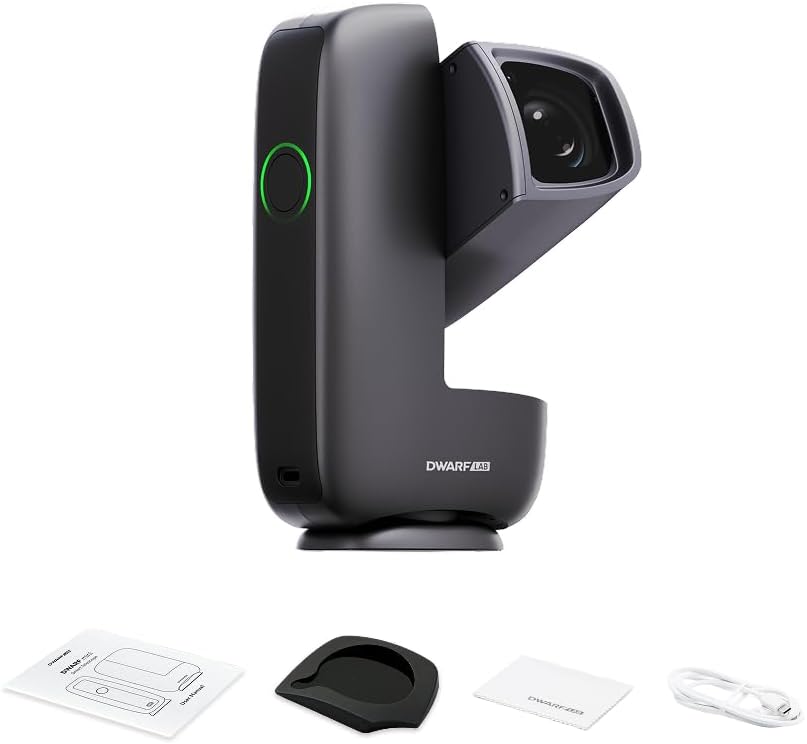
DWARFLAB Dwarf Mini Smart Telescope
30mm at f/5.0, 150mm focal length. Good for bright nebulae, clusters and wide galaxies from a garden; not a planetary instrument.
$419.00 · 287 reviews

ZWO Seestar S30 Pro Smart Telescope
30mm at f/5.3, 160mm focal length — optically within a few percent of the Dwarf Mini. Choose on the app and support, not the aperture.
$699.00 · 220 reviews
A little more aperture in the same size class
The Dwarf 3 is 35 mm, which sounds like a rounding difference and is 1.36× the light of a 30 mm unit —36% more signal per minute on the same target. Its listing does not publish a focal length, so we cannot give its focal ratio. The listing also describes a second, wide-angle lens alongside the main one, aimed at Milky Way and landscape framing; we have not seen what it produces and are only reporting the claim.

DWARFLAB Dwarf 3 Smart Telescope
35mm — 1.36× the light of a 30mm smart telescope, for the same kind of target. Focal length not published on the listing.
$549.00 · 229 reviews
When faint targets are the point: the 85mm step
The Unistellar Odyssey is where the aperture changes category. At 85 mm and f/3.8 it collects 8.0× the light of the 30 mm units and resolves 1.36″, inside the range of ordinary seeing rather than outside it. In practice that means the same galaxy reaches a usable picture in a fraction of the time, which matters most to someone who images on weeknights with an hour to spare.
Be clear about the price of that step. When we checked it cost 6.2× the Dwarf Mini, and it still collects less light than the manual 203 mm Dobsonian in our table. It also carried 27 Amazon ratings against the Dwarf Mini’s 287, so there is less buyer evidence behind it.

Unistellar Odyssey Smart Telescope
85mm at f/3.8 — 8.0× the light of a 30mm smart telescope. For people who image faint galaxies on short sessions.
$2599.00 · 27 reviews
We have not given the Vaonis Vespera 3 a recommendation of its own. At 50 mm it sits between the small units and the Unistellar, with 2.8× the light of a 30 mm unit, but its listing publishes no focal length and carried 1 Amazon rating when we read it. That is too little evidence to send a reader to it. It stays in the table because leaving it out would make the market look tidier than it is.
The one that is really an observatory
The Celestron Origin is a different class of object that happens to share the name. Its listing describes a 152 mm RASA — Rowe-Ackermann Schmidt astrograph — optical design at f/2.2, on a GoTo mount. It collects 26× the light of a 30 mm smart telescope and is the only instrument here whose resolution is finer than ordinary seeing. Celestron sells it as a home observatory, and that is the honest way to think of it: something you set up, not something you carry to the park.

Celestron Origin Intelligent Home Observatory
152mm at f/2.2 — 26× the light of a 30mm smart telescope, resolving 0.76″. A home observatory, not a travel unit.
$4299.00 · 30 reviews
Who should not buy a smart telescope
- Anyone who wants to look. There is no eyepiece on any instrument above. If the experience you are imagining is your own eye at the telescope, the same money buys far more aperture as a manual instrument, and the best Dobsonian telescopes is where to start.
- Anyone whose goal is the planets. The resolution gauge above is the reason. Planetary imaging rewards aperture and focal length, which is the opposite of what a compact smart telescope is built around.
- Anyone who wants to learn the sky. A smart telescope finds everything for you, which is its point. If knowing your way around is part of what you want from the hobby, the trade-off is the same one we price out in GoTo vs manual, only more so.
- Anyone planning to grow into serious astrophotography. A smart telescope is a closed system: you cannot swap the camera, add a guide scope or move the optics to a better mount. Someone who already knows they will go deep is usually better served building around a mount from the start, and the best mount for astrophotography explains why the mount comes first.
There is no product link in this section on purpose. If one of those describes you, the honest recommendation is not a smart telescope, and we are not going to put one in front of you anyway.
Two things you will notice when you shop
Plenty of “smart telescope” listings are not smart telescopes. Search the phrase on Amazon and a good share of the results are conventional refractors with a digital eyepiece or a screen attached, sold under unfamiliar brand names. Their specification tables are unreliable — one we read gives an objective diameter that is physically impossible for a telescope — and none of the three we read lists tracking among its features. We left all of them out of the table rather than compute capability from numbers we do not believe.
One of the best-known models is missing. ZWO’s Seestar S50 is one of the most discussed smart telescopes there is. When we searched Amazon US on 17 September 2026, the telescope itself did not come back — only dew shields, covers and tripods made for it. We will not link a listing we could not find, and we will not compute from a specification we did not read from one, so it is not on this page. If you are weighing it from another retailer, check its aperture against the table above: that single number places it.
What we did not test
We have not used any of these smart telescopes, and we will not pretend otherwise. Everything above is arithmetic on the apertures and focal lengths each listing publishes, plus the prices and rating counts those listings carried on 17 September 2026. That lets us tell you, with confidence, what a 30 mm aperture physically cannot resolve and how much more light each step up collects, because those are properties of the opening and not of the brand.
It does not let us tell you whose app is easier, whose stacking produces cleaner colour, how well any of them copes with a humid night, or how long any company will keep updating its software — and with a smart telescope, the software is half the product. Owner reports on the forums are genuinely better at those questions than any site built from specification tables, including this one.